
The Hidden Epidemic in Your Pet's Mouth
Marlene Siegel, DVM

Bad breath is usually the first thing pet parents notice. It's rarely the first thing that's actually wrong.
By the time an owner catches a whiff of something off, or notices their dog turning away from the food bowl, or spots a swelling along the cheek, periodontal disease has often been progressing quietly for months or years, hidden beneath the gumline where no amount of visual inspection would catch it. And because most pets won't happily open wide for a home dental check, the problem stays invisible until it isn't.
Here's the number that should give every pet owner pause: 80 to 90% of dogs over age three have some degree of periodontal disease, even when their teeth look clean.1 It's the single most common clinical condition seen in dogs and cats, with prevalence estimates ranging from 44% to 100% depending on the population studied.2 This isn't a cosmetic issue; it is a chronic, whole-body inflammatory disease that happens to start in the mouth.
What's actually happening under the gumline
Dental disease doesn't begin with pain or odor; it begins with plaque, a sticky biofilm of bacteria, proteins, fats, and carbohydrates that forms on teeth within hours of eating. Left alone, minerals in saliva harden that plaque into tartar, a substance that bonds firmly to the tooth. This is the point of no return for home care: brushing can slow plaque formation, but nothing short of a professional cleaning removes tartar once it's set.
The more serious damage happens next. Plaque and tartar migrate below the gumline, where bacteria release toxins that erode the tissue and bone anchoring each tooth in place. Because gum tissue is dense with blood vessels, this isn't a contained problem. Bacteria and inflammatory byproducts travel through the bloodstream and have been linked to disease in the heart, kidneys, and liver. 3 Periodontal disease is, in effect, a standing source of chronic inflammation, and chronic inflammation underlies most disease processes in the body.
What raises the risk of disease in your pet's mouth?
Diet. Carbohydrate-heavy processed diets (kibble and canned food) feed the bacteria driving plaque formation. Note that grain-free isn't the same as low-carb; many grain-free formulas simply swap grain for tapioca or potato starch.
Crowded or misaligned teeth. More surface area for food and bacteria to get trapped.
Retained baby teeth. When deciduous teeth don't fall out on schedule, they crowd the adult teeth and compound the risk.
Four stages, one window for reversal:

This staging follows the American Veterinary Dental College's 0–4 periodontal disease classification, based on attachment loss and radiographic bone loss rather than visible tartar alone. 4
The takeaway: stages 1 and 2 are where intervention actually changes the outcome. Past that point, the goal shifts from saving teeth to preventing systemic harm.
Poppy, a patient case, illustrates how integrative therapy can be used alongside conventional treatment to manage oral pain and infection while reducing dependence on repeated antibiotics and other drugs.

The imaging case worth remembering: a tooth with severe root resorption looked unremarkable on visual exam. The damage was only visible on dental radiographs. Without that X-ray, the tooth would have stayed in place, continuing as an untreated source of pain and infection. This is the single strongest argument for radiographs as part of any professional cleaning, not an optional add-on.

When it's allowed to progress
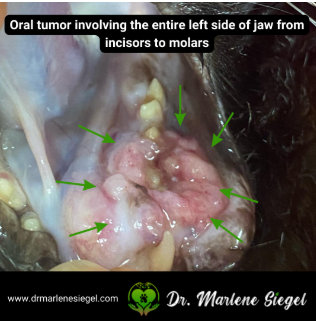
Untreated periodontal disease doesn't plateau; it compounds. Jaw bone weakens to the point of fracture. Infection can tunnel into a fistula connecting the tooth root to the nasal passage, causing facial swelling or nasal discharge. Bone infection (osteomyelitis) can set in. Gum, bone, and tooth loss become permanent.
Watch for: persistent bad breath, bleeding or receding gums, pawing at the mouth, loose or broken teeth, appetite loss, drooling, difficulty chewing, irritability, or discharge around a tooth. Any one of these warrants a look, not a wait-and-see.
The cancer risk owners often miss
Oral cancer is diagnosed in roughly 20 per 100,000 dogs and 11 per 100,000 cats annually, and accounts for about 6 to 7% of all canine cancers and 3% of feline cancers. 5
In dogs, malignant melanoma, squamous cell carcinoma, and fibrosarcoma are the most frequent reported. In cats, squamous cell carcinoma leads, followed by fibrosarcoma. 6
Early red flags: new growths on the gum, tongue, jaw, or palate; swelling of the gums, jaw, or tongue; and any change in gum pigmentation.7
Use anesthesia safety when dental work is required
Anesthesia-free cleanings are discouraged, as they carry their own risks and leave sub-gingival disease unidentified and untreated.8
Proper dental cleanings and extractions require general anesthesia, and that's a legitimate concern for many pet parents, especially with older pets or ones with existing organ stress. An integrative approach doesn't skip anesthesia; it prepares the body for it.
Pre-anesthetic bloodwork. A full panel, not just a basic screen, to assess kidney, liver, or thyroid issues that would change the anesthesia protocol.
Organ support before and after. Nutrient and antioxidant support around the procedure to ease the metabolic load of anesthesia on the liver and kidneys.
Individualized protocols. Working with a veterinarian willing to adjust drug choices and dosing for pets with known sensitivities. Anesthesia should not be a one-size-fits-all approach.
Extensive monitoring. EKG, pulse oximetry, and blood pressure monitoring throughout the procedure to catch changes in real time.
Detoxification through the six organs of elimination
Because oral bacteria and their toxins circulate through the bloodstream, supporting the body's elimination pathways is part of addressing dental disease. The six organs of elimination are the liver, kidneys, lungs, skin, colon, and lymphatic system. Each plays a role in clearing the inflammatory load that chronic gum disease creates.
Liver and kidneys. Filter toxins and metabolic waste from the bloodstream; ongoing inflammation adds to their workload.
Lymphatic system. Moves inflammatory byproducts out of tissue; fascia decompression techniques can support lymphatic flow.
Colon and skin. Support regular elimination and reduce the toxic burden that would otherwise recirculate.
Lungs. Support oxygenation and gas exchange, which underpins cellular repair throughout the body.
Nutraceuticals that support gum and tissue health
Step One: Diet — Replace highly processed, carbohydrate-heavy diets with a species-appropriate, grass-fed/grass-finished raw diet — meat, fat, bone, and organ meats — while supplementing the essential vitamins, minerals, amino acids, and fatty acids the body can't manufacture on its own. This is step one of Dr. Siegel's six steps to health and healing and it does more for oral health than any dental chew.
Alongside diet, targeted supplementation can support healthy gum tissue and slow the inflammatory cascade that drives periodontal disease.
Coenzyme Q10 (CoQ10). Supports cellular energy production in gum tissue and has been studied for gum health in general. Click Here for Dr. Siegel's recommendations
Vitamin C. Supports collagen production, which is needed to maintain the connective tissue anchoring teeth in place. Click Here for Dr. Siegel's recommendations
Omega-3 and 6 balanced fatty acids. Help modulate the inflammatory response contributing to periodontal tissue breakdown. Click Here for Dr. Siegel's recommendations
Antioxidant blends. Help offset oxidative stress associated with chronic low-grade infection in the mouth.
Supporting the oral microbiome
The mouth has its own microbial ecosystem, and a balanced one resists the overgrowth of the specific bacteria that drive periodontal disease. Diet is the biggest lever here (species-appropriate raw feeding supports a healthier oral flora than carbohydrate-heavy processed food), but a few other factors matter too.
Avoid unnecessary antibiotics. Repeated antibiotic use can disrupt oral flora along with gut flora.
Rinses and adjuncts. Hypochlorous acid rinses and ozonated water can help rebalance oral bacteria without disrupting the whole ecosystem the way harsh chemical rinses can.
Chew and saliva flow support. Appropriate raw bones and chews (matched to the individual pet's needs) support natural saliva flow, which itself helps regulate oral bacteria.
Building a real prevention plan
At home:
Diet first. A species-appropriate, grass-fed/grass-finished raw diet, meat, fat, bone, organ, with essential vitamins, minerals, amino acids, and fatty acids the body can't manufacture on its own, does more for oral health than any dental chew.
Look inside the mouth regularly. Lips, back teeth, roof of the mouth, under the tongue. Know what normal looks like so change is easy to spot. Filming the check makes it easier to compare over time.
Brush daily with a finger cot or small pet toothbrush and a non-foaming, chemical-free pet toothpaste.
With your veterinarian:
Annual or biannual oral exams, not just when a problem is already visible.
Diagnostic testing for nutrient deficiencies and toxicities. You can't correct what you haven't measured.
Professional cleaning under anesthesia with full-mouth radiographs. Most root-level lesions, including apical abscesses, are invisible without imaging.
Skip anesthesia-free cleanings. They can't reach below the gumline where disease actually lives, and they risk giving owners false reassurance by removing surface tartar while leaving the real problem untouched.
Advanced procedures like open root planing for pockets that home care and standard cleanings can't reach.
Root canals are not recommended because they remove the tooth's living tissue and leave a dead structure in the mouth — one with microscopic canals that can't be fully sterilized, creating a dark, oxygen-poor pocket where bacteria and biofilm can hide and continue seeding the bloodstream with toxins and inflammation. Extraction removes the infection source entirely and is the preferred option here. 9
Adjunct therapies, ozone saline rinses, hypochlorous acid rinses, and intraoral laser, to support healing after treatment.
The bigger picture
The gut is often called the seat of health. But the mouth is where the gastrointestinal tract begins, making oral care foundational. A healthy oral and gut microbiome starts upstream: reducing toxin load from diet, water, and environment; testing rather than guessing at deficiencies and toxicities; supporting the six organs of elimination and mitochondrial function; and managing physical and emotional stress. Dental disease is rarely just about the teeth. It's usually the most visible signal of what's happening everywhere else.

Further resources: For a complete list of essential supplements, visit www.evolovestore.com. To learn more about supporting the body's own systems for overall pet health and longevity, visit www.transformingvetmedicine.com
References
1. Cornell University Riney Canine Health Center. Periodontal Disease. https://www.vet.cornell.edu/departments-centers-and-institutes/riney-canine-health-center/canine-health-information/periodontal-disease
2. PMC7297050. National Center for Biotechnology Information (NCBI). https://www.ncbi.nlm.nih.gov/pmc/articles/PMC7297050/
3. ScienceDirect. https://www.sciencedirect.com/science/article/pii/S109002332100112X
4. American Veterinary Dental College. Stages of Pet Periodontal Disease. https://afd.avdc.org/five-stages-of-pet-periodontal-disease/
5. Veterinary Cancer Group. Oral Tumors. https://www.veterinarycancer.com/oral-tumors
6. PMC7533385. National Center for Biotechnology Information (NCBI). https://www.ncbi.nlm.nih.gov/pmc/articles/PMC7533385/
7. Journal of Veterinary Science. https://vetsci.org/pdf/10.4142/jvs.2020.21.e70
8. American Veterinary Dental College, Companion Animal Dental Scaling Without Anesthesia (2004 position statement); 2019 AAHA Dental Care Guidelines for Dogs and Cats — both state anesthesia-free scaling is inappropriate due to patient stress, injury risk, aspiration risk, and inability to assess or treat sub-gingival disease.
9. Animal Dental Center of Arizona. Pet Root Canal Treatment. https://animaldentalaz.com/services/pet-root-canal-treatment-endodonics/

Marlene Siegel, DVM
BRMI Veterinary Advisor

Bioregulatory medicine is a total body (and mind) approach to health and healing that aims to help facilitate and restore natural human biological processes. It is a proven, safe, gentle, highly effective, drugless, and side-effect-free medical model designed to naturally support the body to regulate, adapt, regenerate, and self-heal. BRMI is a non-commercial 501(c)(3) foundation and will expand and flourish with your support. Our goal is to make bioregulatory medicine a household term.
This article is for informational purposes only and is not intended to be a substitute for the direct care of a qualified health practitioner who oversees and provides unique and individualized care. The information provided here is to broaden our different perspectives and should not be construed as medical advice, diagnosis, or treatment.


