
How to Supercharge Mitochondrial Health
James Odell, OMD, ND, L.Ac.
One of the most strategic ways to improve energy, strength, stamina, and longevity is by enhancing mitochondrial function. Mitochondria, found in plants, animals, and fungal cells, are essential organelles that act as cellular power plants, providing energy for various bodily functions. When mitochondrial function declines due to aging, illness, or stress, the central nervous system and all organs become vulnerable, leading to fatigue, cognitive decline, and mood changes.
ATP production involves the Krebs cycle and, more importantly, the electron transport chain (ETC), where 90% of ATP is produced. These organelles are crucial for producing adenosine triphosphate (ATP), the body's primary energy currency, which cannot be stored and must be continuously generated. Mitochondria can occupy up to 25% of a cell's volume and produce billions of ATP molecules daily. A healthy person produces approximately 1200 watts of energy each day. The brain, utilizing 70% of this ATP, highlights the link between mitochondrial health and neurological well-being.
As people age, mitochondria naturally decline, emphasizing the need to optimize the function of the remaining mitochondria. Mitochondria are susceptible to nutrient deficiencies, toxins, and oxidative damage. Supporting mitochondrial health can be achieved through nutrition, food supplementation, as well as certain light frequencies and movement.
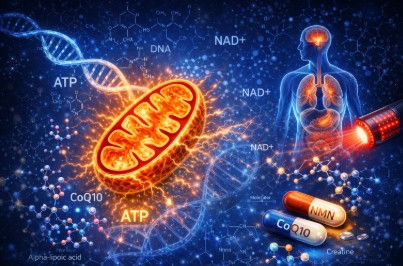
The following are 6 food supplements to supercharge mitochondrial health.
Coenzyme Q10: The Spark Plug of Cellular Energy
Coenzyme Q10 (CoQ10), also known as ubiquinone, is a naturally occurring biochemical cofactor (coenzyme) and an antioxidant produced by the human body. Ubiquinone and ubiquinol are two forms of Coenzyme Q10 (CoQ10); ubiquinone is the oxidized form, while ubiquinol is the reduced, active antioxidant form, and the body constantly converts between them for energy production and cell protection, though ubiquinol is often recommended for older adults or those with absorption issues as it's more readily utilized. Ubiquinol directly fights free radicals and supports mitochondrial function, but standard ubiquinone supplements are well-researched and effective, especially when the body converts it efficiently, with soft-gel formulas often enhancing absorption for both forms.
CoQ10 is a critical component of the mitochondrial electron transport chain, where it plays a role in oxidative phosphorylation, a process required for the biosynthesis of adenosine triphosphate, the primary energy source of cells. It is also an antioxidant. Oxidative stress in cells primarily results from oxygen and electron leakage from mitochondria, which increases with deficiencies in nutrients like CoQ10, especially in statin-users.
The rationale of exogenous supplementation of CoQ10 is to bypass defects in the respiratory chain, reducing electron leaks and restoring ATP synthesis. Normal dosages range from 100 to 300 mg daily.
Creatine Monohydrate: Fueling High-Demand Energy Systems
Creatine monohydrate is an antioxidant and a potential energy source for defective mitochondria through the phosphocreatine system. It also works as an energy shuttle of ATP and phosphates from mitochondrial sites to the cells’ cytoplasm. It is commonly used by athletes as a dietary supplement to increase muscle performance in short-duration and high-intensity resistance exercises.
The standard and most recommended daily dosage for creatine monohydrate is 3 to 5 grams. The administration of creatine monohydrate (at the oral dosage of 5 g twice daily for 14 days, followed by 2 g twice daily for 7 days) has been shown to significantly improve physical performance and reduce post-exercise lactate. Conversely, no significant effects were observed in lower intensity aerobic activities.
Alpha-Lipoic Acid: The Universal Antioxidant for Mitochondrial Protection
Alpha-lipoic acid (ALA) is an antioxidant supplement that helps convert glucose into energy and may support nerve health. It is commonly used for diabetic neuropathy. ALA is present in mitochondria as a cofactor for pyruvate dehydrogenase and α-ketoglutarate dehydrogenase. Its primary role in mitochondrial function is scavenging reactive oxygen species or oxidative free radicals, generated by defective oxidative phosphorylation, decreasing oxidative stress in mitochondria and the cell’s membranes. It may also enhance the uptake of phosphocreatine as an alternative energy source to anaerobic glycolysis in defective mitochondrial chain defects.
Normal dosages range from 600 to 1200 mg daily. Be advised that R-ALA is the naturally occurring, active form of alpha-lipoic acid and offers enhanced antioxidant activity compared to the less active S form.
Riboflavin (B2): The Unsung Hero Behind Energy Metabolism
Mitochondria rely significantly on flavoenzymes, such as oxidases, reductases, and dehydrogenases. Flavoenzymes are functionally dependent on biologically active flavin adenine dinucleotide (FAD) or flavin mononucleotide (FMN), which are derived from the dietary component riboflavin, a water-soluble vitamin (B2). Riboflavin regulates the structure and function of flavoenzymes through its cofactors FMN and FAD, thus protecting cells from oxidative stress and apoptosis.
Hence, it is not surprising that any disturbance in riboflavin metabolism and absorption of this vitamin may have consequences for cellular FAD and FMN levels, resulting in mitochondrial dysfunction and reduced energy levels, which can lead to riboflavin-associated disorders, such as cataracts, neurodegenerative diseases, and cardiovascular diseases.
The suggested oral dosage of riboflavin is 50-400 mg daily, in both children and adults. To be utilized by the body, however, riboflavin must first be converted to its active form – riboflavin 5′-phosphate (R5P). A compromised digestive system, however, can adversely affect the body’s ability to convert riboflavin to R5P. And certain prescription medications can also compromise the absorption of riboflavin, putting it in a state of deficiency. Thus, the more specialized (phosphorated) form, riboflavin 5'-phosphate (R5P), may be better for individuals who have difficulty converting standard riboflavin into its active form. The suggested dosage of R5P ranges from 20 to 50 mg daily.
Folate & Methylation: Essential Drivers of Mitochondrial DNA and Repair
The term folate refers to a family of compounds belonging to the B vitamins, acting as coenzymes in carbon-transfer reactions. Natural folates that are derived from food are called reduced forms of folate, which are readily bioactive. Be advised that folic acid is a type of folate that is most commonly used in vitamin supplements and is used to fortify our foods. However, folic acid is the synthetic, oxidized form of folate and is very poorly utilized and is inferior to the active form of folate 5-methyltetrahydrofolate (5-MTHF). 5-MTHF, the biologically active form of folate, may be purchased as a supplement. I wrote an article explaining the differences between folate and folic acid that can be accessed from here. https://www.brmi.online/post/are-you-confused-by-the-difference-between-folic-acid-and-folate
The known metabolic activities of folate compounds or their derivatives are the purine synthesis and the methylation of homocysteine to methionine. Folate is crucial for mitochondria, supporting vital one-carbon (1C) metabolism within these organelles for making DNA building blocks (purines/thymidylate), protein synthesis, and maintaining the methionine cycle for cellular methylation, impacting cell proliferation, energy, and epigenetics. Mitochondria have their own distinct folate pathways, distinct from the cytosol, and play roles in cellular defense by hoarding folate to starve invading pathogens like parasites, while folate deficiency can impair mitochondrial DNA and function, making it a target for therapies in mitochondrial diseases and cancer. Folate deficiency is quite common in patients affected by mitochondrial dysfunction, and it could worsen mitochondrial metabolism.
Due to the high incidence of methylation defects (genomic polymorphisms) in the population, it is best to supplement with the methylated form of folate— 5-methyltetrahydrofolate. A suggested dosage of 5-MTHF is between 3 and 10 mg.
NAD+: The Master Regenerator of Cellular Vitality
NAD is a biomolecule present in all living cells. NAD exists in an oxidized form (NAD+) and a reduced form (NADH). The most important function of NAD+ is as an oxidizing agent in cellular metabolism. (The reduced form, NADH, conversely acts as a metabolic reducing agent.) NAD+ also has roles in adenosine diphosphate (ADP)–ribose transfer reactions that involve the poly(ADP-ribose) polymerase enzyme 1 (PARP1) and several other enzymatic processes.
Promising preclinical findings indicate that increasing NAD+ abundance is linked to improvements in physiological function and select markers of lifespan and health. NAD+ precursors, such as nicotinamide riboside, nicotinamide mononucleotide, nicotinamide, and nicotinic acid (niacin), are supplemented in an attempt to increase NAD+. Increasing NAD+ can improve outcomes such as glucose and insulin regulation, mitochondrial oxidative metabolism, muscle and physical functioning, vascular function, and cognitive function. It truly is a remarkable molecule with numerous health benefits.
NAD is available by injection and even through transdermal patches. NAD precursors such as nicotinamide riboside and nicotinamide mononucleotide are available for oral consumption. Clinical studies have demonstrated that these oral NAD+ precursors may increase NAD+ levels in the brain and muscle. However, data on the NAD-boosting effect of nicotinamide riboside and nicotinamide mononucleotide in tissues other than blood is limited to muscle and brain at this time.
Beyond supplementation, additional methods to bolster mitochondrial function include:
Red Light Therapy: Illuminating the Path to Better Mitochondria
Mitochondria are thought to be a likely site for the initial effects of light, leading to increased ATP production, modulation of reactive oxygen species, and induction of transcription factors. Red light therapy works by stimulating mitochondria to produce more energy in the form of ATP. This is achieved when cytochrome c oxidase, an enzyme in the mitochondrial respiratory chain, absorbs light photons, leading to a series of reactions that boost cellular energy, reduce inflammation by releasing nitric oxide, and improve healing by promoting blood flow. These effects in turn lead to increased cell proliferation and migration (particularly by fibroblasts), modulation in levels of cytokines, growth factors, and inflammatory mediators, and increased tissue oxygenation. There are many commercial devices available that produce red light
Nutrient-Rich Foods & Spices: Everyday Support for Cellular Energy
To improve mitochondria, focus on leafy greens (spinach, kale), cruciferous veggies (broccoli, cauliflower), colorful produce (beets, carrots, berries), and sulfur-rich onions/garlic. Additionally, olive oil, avocado, nuts, pumpkin, and chia seeds are great sources of healthy fats.
Spices like turmeric, ginger, garlic, cinnamon, rosemary, holy basil, and black pepper boost mitochondrial health by reducing inflammation, fighting oxidative stress (free radicals), enhancing antioxidant defenses, promoting new mitochondria (biogenesis), and improving energy (ATP) production.
Fermented foods support mitochondrial health by providing beneficial microbes and postbiotics (metabolites) that reduce oxidative stress, improve gut barrier function, and create compounds like butyrate, a crucial fuel for colon cells, all leading to better cellular energy (ATP) production, reduced inflammation, and enhanced mitochondrial function through a strong gut-mitochondria crosstalk. Fermented items like kimchi, kefir, and sourdough are rich in probiotics, B vitamins, and antioxidants, making them a key part of a diet that supports these vital cell powerhouses.
Exercise: Building Stronger, Smarter Mitochondria
Exercise improves mitochondrial health by stimulating processes like mitochondrial biogenesis (creating new mitochondria) and mitophagy (removing damaged ones). This leads to increased mitochondrial number and function, which enhances the body's ability to produce energy, and can be achieved through both aerobic and strength training.
Concluding Thoughts: Nourishing Your Cells for Lifelong Energy and Supercharged Mitochondrial Health
Adequate nutrient levels are essential for mitochondrial function as several specific micronutrients play crucial roles in energy metabolism and ATP-production. We have addressed the roles of certain B vitamins such as folate and riboflavin, coenzyme Q10, creatine monohydrate, alpha-lipoic acid, and NAD. These may be taken in combination or separately. It is important before embarking on any new supplement regimen, to first consult your health-care professional. Red light, nutrient-rich foods and spices, and all-important exercise are also key to mitochondrial health.
References
Balasubramaniam, Shanti, and Joy Yaplito-Lee. "Riboflavin metabolism: role in mitochondrial function." Journal of translational genetics and genomics 4, no. 4 (2020): 285-306.
Camara, Amadou KS, Edward J. Lesnefsky, and David F. Stowe. "Potential therapeutic benefits of strategies directed to mitochondria." Antioxidants & redox signaling 13, no. 3 (2010): 279-347.
Depeint, Flore, W. Robert Bruce, Nandita Shangari, Rhea Mehta, and Peter J. O’Brien. "Mitochondrial function and toxicity: role of the B vitamin family on mitochondrial energy metabolism." Chemico-biological interactions 163, no. 1-2 (2006): 94-112.
Han, Liguang, Chi-Tang Ho, and Muwen Lu. "Regulatory Role of Bioactive Compounds from Natural Spices on Mitochondrial Function." Journal of agricultural and food chemistry 73, no. 10 (2025): 5711-5723.
Lenaz, Giorgio, Romana Fato, Gabriella Formiggini, and Maria Luisa Genova. "The role of Coenzyme Q in mitochondrial electron transport." Mitochondrion 7 (2007): S8-S33.
Tanaka, Tomohiro, Akiyuki Nishimura, Kazuhiro Nishiyama, Takumi Goto, Takuro Numaga-Tomita, and Motohiro Nishida. "Mitochondrial dynamics in exercise physiology." Pflügers Archiv-European Journal of Physiology 472, no. 2 (2020): 137-153.
Giuliani, Alessandro, Luca Lorenzini, Michele Gallamini, Alessandro Massella, Luciana Giardino, and Laura Calzà. "Low infra red laser light irradiation on cultured neural cells: effects on mitochondria and cell viability after oxidative stress." BMC complementary and alternative medicine 9, no. 1 (2009): 8.
Hood, David A., Liam D. Tryon, Anna Vainshtein, Jonathan Memme, Chris Chen, Marion Pauly, Matthew J. Crilly, and Heather Carter. "Exercise and the regulation of mitochondrial turnover." Progress in molecular biology and translational science 135 (2015): 99-127.
Johannsen, Darcy L., and Eric Ravussin. "The role of mitochondria in health and disease." Current opinion in pharmacology 9, no. 6 (2009): 780-786.
Marshall, Robert Percy, Jan-Niklas Droste, Jürgen Giessing, and Richard B. Kreider. "Role of creatine supplementation in conditions involving mitochondrial dysfunction: a narrative review." Nutrients 14, no. 3 (2022): 529.
Umino, Yuki, and Mitsuhiro Denda. "Effect of red light on epidermal proliferation and mitochondrial activity." Skin Research and Technology 29, no. 9 (2023): e13447.
Vargas-Mendoza, Nancy, Marcelo Angeles-Valencia, Ángel Morales-González, Eduardo Osiris Madrigal-Santillán, Mauricio Morales-Martínez, Eduardo Madrigal-Bujaidar, Isela Álvarez-González et al. "Oxidative stress, mitochondrial function and adaptation to exercise: new perspectives in nutrition." Life 11, no. 11 (2021): 1269.
Walsh, Brandon, Michail Tonkonogi, Karin Söderlund, Eric Hultman, Valdur Saks, and Kent Sahlin. "The role of phosphorylcreatine and creatine in the regulation of mitochondrial respiration in human skeletal muscle." The Journal of physiology 537, no. 3 (2001): 971-978.
Wang, Yi, Xiaojie Li, Yuming Guo, Lawrence Chan, and Xinfu Guan. "α-Lipoic acid increases energy expenditure by enhancing adenosine monophosphate–activated protein kinase–peroxisome proliferator-activated receptor-γ coactivator-1α signaling in the skeletal muscle of aged mice." Metabolism 59, no. 7 (2010): 967-976.
Wesselink, E., W. A. C. Koekkoek, S. Grefte, R. F. Witkamp, and A. R. H. Van Zanten. "Feeding mitochondria: Potential role of nutritional components to improve critical illness convalescence." Clinical Nutrition 38, no. 3 (2019): 982-995.

Bioregulatory medicine is a total body (and mind) approach to health and healing that aims to help facilitate and restore natural human biological processes. It is a proven, safe, gentle, highly effective, drugless, and side-effect-free medical model designed to naturally support the body to regulate, adapt, regenerate, and self-heal. BRMI is a non-commercial 501(c)(3) foundation and will expand and flourish with your support. Our goal is to make bioregulatory medicine a household term.
This article is for informational purposes only and is not intended to be a substitute for the direct care of a qualified health practitioner who oversees and provides unique and individualized care. The information provided here is to broaden our different perspectives and should not be construed as medical advice, diagnosis, or treatment.


