Electro-Magnetic Spectrum Therapy: Bridging Physics, Physiology, and the Body’s Innate Wisdom

BRMI Staff
A Comprehensive, Accessible Bioregulatory Medicine Exploration
Introduction: Living in a Sea of Light, Color, and Charge
Long before humans understood electricity, before Maxwell described electromagnetic fields, and even before the concept of a “cell” existed, we were already immersed in the electromagnetic spectrum. Every living organism—plants, animals, humans—baths in a continuous ocean of invisible waves: light, heat, magnetism, and subtle electrical fields.
Every cell continuously emits tiny bursts of light (called biophotons). Every heartbeat creates a ripple of electromagnetic force measurable several feet from the body. Every nerve impulse is literally an electrical signal. The connective tissue beneath our skin conducts microcurrents. Mitochondria interact with photons to make energy. Even the structure of water inside the body depends on electromagnetic interactions.
We are not only biochemical beings. We are electrodynamic organisms—living matrices of oscillation, resonance, and light.
Electro-Magnetic Spectrum Therapy (EMST) taps into this fundamental truth. It is a family of therapeutic methods that use different parts of the electromagnetic spectrum—ranging from extremely low frequencies to visible light— to help restore balance, repair tissues, and support self-regulation.
The Body as an Electrodynamic System
(What does that actually mean?) To say the body is “electrodynamic” simply means: We function through electrical and electromagnetic processes just as much as chemical ones.
This helps explain why EM therapies work so well—because they match what the body already does naturally.
Cells Communicate Through Light
(What are biophotons, and why do they matter?) In the 1970s, German biophysicist Dr. Fritz-Albert Popp discovered that cells emit extremely tiny pulses of light called biophotons.
Biophotons explained simply:
They are ultraweak photons (light particles) naturally produced by cells.
They are measured with sensitive devices in the UV and visible light range.
They appear organized, not random—almost like the body’s own “laser signals.”
Popp showed that:
Healthy cells emit coherent light – meaning the photons are synchronized, ordered, and information-rich (similar to the structure of laser light).
Stressed or diseased cells emit incoherent light – disordered, noisy, and less effective for communication.
This suggests that the body may use light to coordinate internal processes—much like an internal communication network.
In simple terms: Biophotons may help cells “talk” to one another and stay organized. Illness disrupts this communication. Electromagnetic therapies may help restore order.
Your Connective Tissue Is a Semi-Conductor
(Yes—like the material inside computers.) Connective tissue (fascia, collagen, extracellular matrix) is not just padding. It behaves like a liquid-crystal semiconductor—a material that conducts small electrical charges in organized ways.
Put simply:
Your tissues can carry electrical information.
They respond to pressure, stretch, sound, and electromagnetic fields.
They help coordinate healing signals throughout the body.
This means EM therapies don’t force change; they often remind tissues how to self-organize.
The Heart & Brain as Field Generators
Both the heart and brain produce electromagnetic fields.
Heart field (simple definition): The heart’s electrical system creates a magnetic field detectable several feet from the body. This field shifts with emotional states and autonomic tone.
Brain field (simple definition): Brain waves (alpha, beta, gamma, etc.) are electromagnetic patterns created by synchronized neuronal firing.
Why this matters: Therapies that influence electromagnetic patterns can affect:
mood
focus
heart rate variability
vagal tone
stress physiology
This is the foundation for the “entrainment” effects we’ll discuss later.
The Electromagnetic Spectrum… in Human Language
Here’s a common problem: the electromagnetic spectrum is usually explained in physics terms only scientists understand. Let’s fix that.
Think of the EM spectrum like a piano keyboard:
Low notes = longer wavelengths (like PEMF, microcurrent)
Mid notes = visible light and infrared
High notes = ultraviolet and beyond
Different therapies use different “notes” to achieve different biological effects.
Where therapeutic EMST occurs:
ELF / PEMF (1–1000 Hz) = very low “notes”
Microcurrent = tiny electrical currents
Infrared (IR) = gentle warming wavelengths
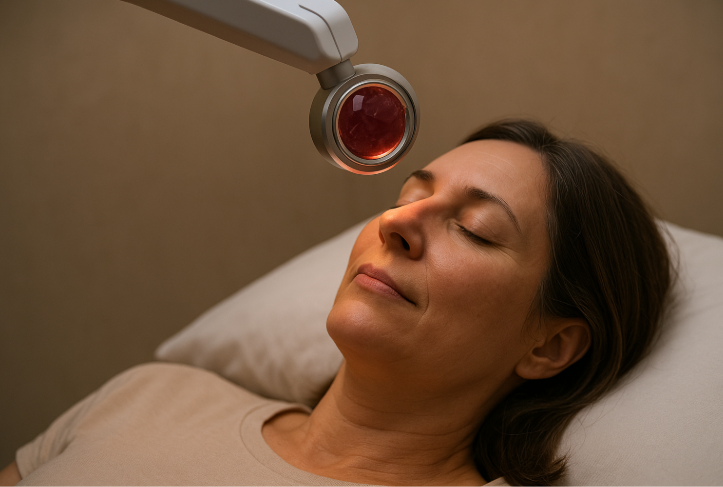
Photobiomodulation (red & near-IR) = light that fuels mitochondria
Radiofrequency (RF) = mid-level waves that interact with nerve pathways
You don’t need to memorize the spectrum to understand EMST—just know that different parts of the spectrum have different healing roles.

Therapeutic Modalities Across the Spectrum
PEMF: Pulsed Electromagnetic Field Therapy
What it is: A therapy that sends gentle pulses of magnetic energy into tissues.
Why it matters: These frequencies resemble the Earth’s natural electromagnetic rhythms (like the Schumann resonance).
What PEMF actually can do:
Recharge the cell membrane (helping nutrients in and waste out).
Stimulate ATP (energy) production.
Reduce inflammation.
Improve blood flow and oxygen delivery.
Support bone and tissue repair.
PEMF helps “wake up” tired, inflamed, or low-energy cells by giving them the electrical push they need to function normally again.
Microcurrent Therapy (MCT)
What it is: Microcurrent uses extremely small electrical signals—so small that they mirror natural currents inside your own tissues.
What it does:
Boosts energy production inside cells by up to 300%.
Helps tissues repair faster.
Reduces pain by calming irritated nerves.
Restores normal electrical flow in tissues.
Easy analogy:
If PEMF is the “magnetic reminder” to cells, microcurrent is like “precision electrical nutrition”—the exact levels of electricity your cells already use.
Frequency-Specific Microcurrent (FSM)
What it is: FSM uses very precise frequencies chosen to match the “resonant signatures” of specific tissues.
Think:
The liver has a different frequency than the fascia.
Nerves differ from muscles.
Scar tissue differs from healthy tissue.
FSM pairs two frequencies:
One for the type of tissue
One for the condition being treated
Why this works:
Every structure in the universe vibrates at a natural frequency—even biological tissues. FSM attempts to entrain tissues back into harmony by matching these frequencies.
Infrared Therapy (IR)
What it is: Infrared is the gentle, penetrating warmth you feel from sunlight or a sauna.
What infrared does biologically:
Increases circulation
Helps muscles relax
Improves detoxification
Enhances lymphatic flow
Supports mitochondrial energy production
Infrared therapy works because humans naturally emit and absorb infrared radiation. It is literally part of our energetic identity.
Photobiomodulation (PBM)
What it is: PBM uses very specific red and near-infrared light to stimulate mitochondrial activity—like giving your cells a “light vitamin.”
How does light make energy?
Inside the mitochondria, an enzyme called cytochrome c oxidase absorbs these wavelengths. This absorption increases ATP production and reduces oxidative stress.
Main benefits:
Faster healing
Reduced inflammation
Better cognitive function
Improved nerve regeneration
Enhanced mood and sleep regulation
Where Popp’s theory comes in:
PBM may help restore coherent biophoton emissions—meaning your cells emit more organized, healthier patterns of light.
Radiofrequency (RF)
What it is: RF uses mid-frequency electromagnetic waves to interact with nerves and tissues.
At high intensity, RF can heat tissues (used in ablation or aesthetics). But in therapeutic low-intensity RF, the goal is not heating.
Instead, RF may:
Calm overactive nerves
Reduce pain
Influence inflammatory pathways
RF is still evolving but shows promise as a regulatory therapy.
Electromagnetic Spectrum Therapy and the Bioregulatory Model
Bioregulatory medicine believes healing happens when the body:
restores order
improves communication
balances the autonomic nervous system
normalizes cellular energy
EM therapies support all four.
In the simplest terms: They help the body remember how to heal itself.
Resonance, Entrainment, and Coherence
These three concepts come from physics, but they apply beautifully to human biology.
Resonance
Definition: Every object prefers to vibrate at certain frequencies. Push it at that frequency and it responds strongly.
Biological example: Your vagus nerve has a resonant frequency. Your heart cells do too. So does fascia.
FSM or PEMF can interact with tissue resonance to restore harmony.
Entrainment
Definition: Two oscillating systems begin to synchronize.
Common examples:
People walking side by side naturally fall into step
Pendulum clocks on the same wall synchronize
Heart and breathing rhythms can become coherent
In EMST:
Electromagnetic inputs can help:
regulate sleep cycles
calm anxiety
balance sympathetic/parasympathetic tone
Coherence
This is the heart of bioregulatory physics.
Definition: Coherence is orderly, synchronized energy flow.
Why it matters:
Healthy tissues emit coherent light
Illness corresponds to chaotic, incoherent emissions
EMST helps restore coherence by re-introducing structured, rhythmic signals.
Safety, Dosing & Practical Considerations
General guidance:
Start low and slow
More intensity is not always better
Frequency often matters more than strength
Dosing Matters
Lower frequencies tend to influence regulatory processes.
Higher frequencies influence heating, nerve conduction, or chromophore interactions.
Microcurrent and PBM follow a biphasic dose curve: more is not better.
Common-sense contraindications:
Pacemakers (PEMF, microcurrent)
Pregnancy (RF caution)
Photosensitive conditions (PBM)
Active hemorrhage
What EMST Can Help With:
A non-exhaustive list:
Chronic pain
Fibromyalgia
Neuropathy
Wound healing
Bone repair
Depression and anxiety
Cognitive decline
Lymphatic congestion
Detoxification support
Autonomic dysregulation
Mitochondrial dysfunction
Sleep dysregulation
Psoriasis
These therapies shine when chemistry alone (supplements, pharmaceuticals) feels insufficient—because the underlying issue is energetic, regulatory, or communication-based.
The Future: Coherence Medicine
We are entering an era where medicine acknowledges that:
The body uses light to communicate
The ECM functions electrically
Mitochondria respond to photons
Fields organize biochemical processes
Health = coherence
The next wave of healing modalities may center around personalized field-based treatments, biophoton analysis, and AI-driven frequency mapping.
Conclusion: Returning to the Body’s Light-Based Intelligence
Electromagnetic therapy is not futuristic. It is ancient. It is embedded in our physiology. It is how our cells communicate, regulate, and heal.
EMST doesn’t overpower biology—it harmonizes with it. By embracing the body as an electrodynamic organism—one that thrives on rhythm, coherence, charge, and light—we unlock a profound new dimension of healing. This is not alternative medicine. This is original medicine—the physics beneath physiology.
References
Cheng, Nick, Matthew Van Hoof, Roger B. Bockx, and Paul W. Hoogmartens. 1982. “The Effects of Electric Currents on ATP Generation, Protein Synthesis, and Membrane Transport.” Clinical Orthopaedics and Related Research 171: 264–72.
Funk, Richard Hermann, Thomas Monsees, and Nilufar Özkucur. 2009. “Electromagnetic Effects—From Cell Biology to Medicine.” Progress in Histochemistry and Cytochemistry 43 (4): 177–264.
Hamblin, Michael R. 2016. “Mechanisms and Applications of the Anti-Inflammatory Effects of Photobiomodulation.” AIMS Biophysics 3 (3): 337–61.
McMakin, Carolyn. 2011. Frequency Specific Microcurrent in Pain Management. Edinburgh: Churchill Livingstone.
Popp, Fritz-Albert. 1992. “About the Coherence of Biophotons.” In Macroscopic Quantum Coherence, edited by Marlan O. Scully and Subhash Singh, 1–12. Dordrecht: Springer.
Ross, Chris L. 2019. “The Use of Electromagnetic Field Therapies in Clinical Practice.” Medical Devices: Evidence and Research 12: 457–67.
Salehpour, Farzad, and Michael R. Hamblin. 2020. “Photobiomodulation for Cognitive Impairment and Dementia: A Review.” Journal of Alzheimer's Disease 74 (1): 1–18.
Ventura, Carlo, et al. 2011. “Cellular Bioenergetics and Electromagnetic Signaling.” Biochimica et Biophysica Acta (BBA) – Bioenergetics 1807 (6): 674–83.
Pawluk, William. 2013. PEMF: The Fifth Element of Health. Baltimore: FriesenPress.

Bioregulatory medicine is a total body (and mind) approach to health and healing that aims to help facilitate and restore natural human biological processes. It is a proven, safe, gentle, highly effective, drugless, and side-effect-free medical model designed to naturally support the body to regulate, adapt, regenerate, and self-heal. BRMI is a non-commercial 501(c)(3) foundation and will expand and flourish with your support. Our goal is to make bioregulatory medicine a household term.
This article is for informational purposes only and is not intended to be a substitute for the direct care of a qualified health practitioner who oversees and provides unique and individualized care. The information provided here is to broaden our different perspectives and should not be construed as medical advice, diagnosis, or treatment.